Insight · bids
A bid library that wins the second time
Reuse is not copy-paste. A bid library earns its keep when every answer arrives with evidence attached.

The first bid takes three weeks and produces two hundred pages. The second takes four weeks, because nobody can find the good answer from the first one, so it gets rewritten by someone with less context and more optimism.
A library solves this only if it is built around evidence rather than prose. Prose ages; a case reference with a number in it does not.
Structure the answer, not the document
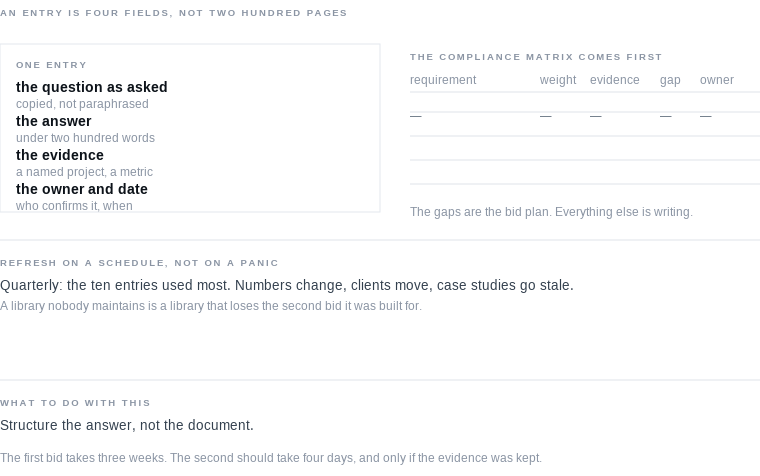
Each entry: the question as asked, the answer in under two hundred words, the evidence — a named project, a metric, a client that will confirm — and an owner who is accountable for its accuracy. Four fields, and the fourth is the one that keeps the other three honest.
Tag by question type, sector and capability, so retrieval works on the way a bid team thinks: “what have we said about data migration for a regulated client?”
The compliance matrix comes first
Before writing, turn the requirement document into a matrix: requirement, weight, evidence held, gap, owner. The gaps are the bid plan. Teams that write first and map later spend the last week discovering a mandatory requirement they cannot answer.
The matrix also decides what not to write. A requirement worth two per cent should not consume a day of a solution architect’s time, and the only way to make that call is to have the weights in front of you on day one.
Refresh on a schedule, not on a panic
Quarterly, take the ten entries used most and check them. Numbers change, clients move, case studies get stale. A library nobody maintains becomes a liability, because it makes old claims look current — and the one that gets caught is the one that loses the bid.
The measure is not how many entries exist. It is how much of a new bid is assembled from entries that were already reviewed, and how many gaps the matrix had at kickoff. Both numbers go the right way only if someone owns the library between bids.

Working through this now?