Insight · pricing
Discount rules are a programming language
Once promotions can stack, the pricing engine has become code. Treat it like code, or it will cost you money quietly.

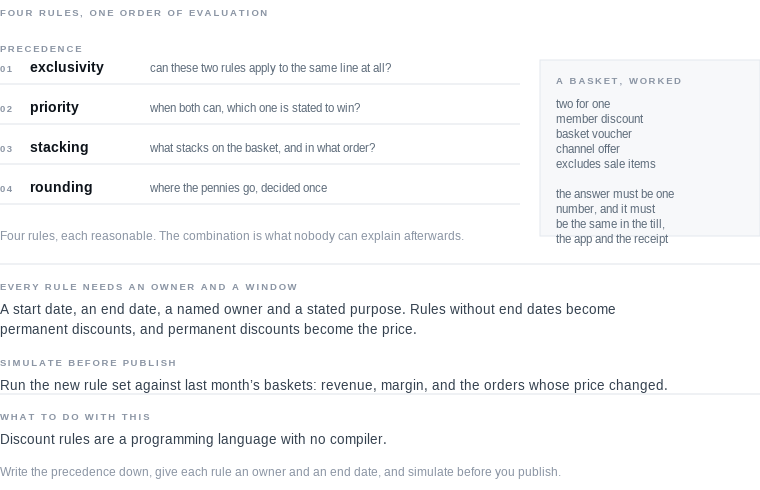
Buy two get one free, plus a member discount, plus a basket-level voucher, plus a channel-specific offer that excludes sale items. Four rules, each reasonable, and a combination nobody modelled — which the customer found on the first weekend.
Every promotion engine eventually becomes a programming language. The only question is whether it is one with tests, owners and a release process, or one that lives in a spreadsheet and a merchandiser’s memory.
Precedence has to be explicit
When two rules apply, the outcome must be determined by a stated order — exclusivity first, then priority, then best-value-for-customer as a final tiebreak. If the engine cannot say which rule won and why, the pricing team cannot explain the receipt, and the contact centre inherits the argument.
Store the winning rule on the transaction. It costs one column and saves a week per quarter.
Every rule needs an owner and a window
A start date, an end date, a named owner, and a stated purpose. Rules without end dates become permanent discounts, and permanent discounts become the price. Half of the margin leakage we have found in retail was not fraud or error; it was promotions that nobody turned off.
The owner matters as much as the date. A rule with an owner gets reviewed when the market changes; a rule with a team name gets inherited.
Simulate before publish
Run the new rule set against last month’s baskets and show three numbers: revenue, margin, and the count of orders whose price changed. If margin falls by more than the promotion was budgeted to spend, the rule is wrong before it is live.
Then test the combinations deliberately. The stack is the risk, not the individual offer — and the stack is where the customer, and the finance team, will find you.
The measure of a mature engine is not how many promotions it can express. It is whether a merchandiser can answer, in one screen, why a specific basket was priced the way it was.

Working through this now?