Insight · AI and capability
Nobody becomes senior without being in the room
A senior is not the person who has done the most work. It is the person who can answer in the room, without asking the model. That capacity is made in one place — and automation is emptying it.
The question arrives about forty minutes into the meeting, and nobody prepared for it. The client is looking at you. There is no good way to say: hold on, let me ask the AI.
Someone in that room has to answer. They have to answer with what they have, in front of everyone, and then live with it — because the decision will be taken on the strength of that answer whether or not it turns out to be right.
That is the job. Not the analysis. The answer, in the room, under observation, with no time to look it up.
So it is worth being precise about where that capacity comes from, because the usual answer — experience — is not quite it. Plenty of people have twenty years and still cannot do it. What they have is twenty years of work; what they lack is twenty years of rooms.
Capability used to have one supply chain
Feng Ji’s essay on the post-AI era — 8,000 words, published on 27 November — is mostly about games, and about who should own the output once intelligence stops being scarce. One passage describes the constraint that made the apprenticeship necessary in the first place.
在此之前,无论多高深的学问、多老辣的判断与直觉,统统长在活生生的人脑里。当资本可以直接拿电费去批发智力,它向普通人购买工时的必要性,便从根子上动摇了。
However deep the learning, however seasoned the judgement and intuition, it all lived in a living human brain. And once capital could wholesale intelligence at the price of electricity, the necessity of buying hours from ordinary people was uprooted at the foundation.
Read that as a manager rather than an economist, and the consequence is not about headcount. It is about supply. If judgement and intuition could only ever be obtained by growing a person, then growing people was never a development programme. It was procurement — the only way to get the capability at all.
There is another way now. So an activity that used to be procurement is being reclassified as overhead, and it loses that argument every time: it is slow, the output is unreliable, and it arrives in ten years.
The ticket in was never the training
This is where the obvious version of the argument goes wrong, including the version I first wrote. The junior rung did not train anyone by handing them ticket triage. Triage taught them what the data looks like when it is wrong — useful, and not the thing that answers a client.
The room is where it happened. Standing next to someone senior while a client asked something unscripted. Watching a decision get made on incomplete information, then watching the same person defend it a week later when it turned out to be wrong. Being allowed to answer badly, in front of someone who could absorb the cost of it.
None of that is taught. It is absorbed, and it needs two things: a room with something at stake, and a senior willing to be slowed down by someone who is not yet useful.
The routine work was only ever the ticket that got a junior into that room. Nobody called it training, because it wasn’t.
夹在中间的绝大多数从业者,哪怕每天把工具用得再熟练,每一次在屏幕上的精调与交付,本质上都是在替那个即将绕开自己的系统贡献训练语料。
However fluent the people in the middle become with the tools, every refinement and every delivery they make on a screen is, in substance, contributing training corpus to the system that is about to route around them.
That is the asymmetry in one sentence. When the work was done by a junior, two things compounded at once: the model learned the shape of the exception, and the junior earned a seat. Automate the work and only the first still happens. The corpus goes into the vendor’s weights; the seat is never offered, because nobody needs notes taken in a meeting the model has already summarised.
The room empties. Nobody decides to empty it.
Protect the seat, not the task
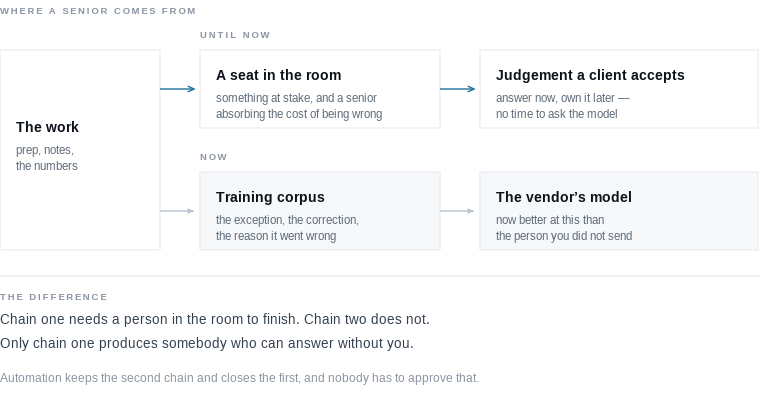
“Keep some of the work human” is the wrong ask, and it is also the ask that loses. Most of this work should be automated; the arithmetic is not close. The thing worth protecting is narrower and much cheaper: the seat. A person who is not yet good at this, in a room, with something at stake.
Per role family, write three things down:
- Which rooms a junior must be in this year — named meetings, not categories.
- Who is responsible for getting them there, and for answering the client’s “why is he in this meeting”.
- What you accept as the cost — a slower hour, a wrong question in front of a client, a senior’s afternoon that produced nothing billable.
Then review it once a year against the only measure that matters: how many people could now answer that question with you out of the room.
A room staffed entirely with competent people produces no successors. That is the whole failure, and it is invisible in every report you own, because an empty seat never appears as a variance.
The line nobody writes
人不是生产的手段,人只能是生产的目的。
A person is not a means of production. A person can only be the end of it.
Feng Ji means that as a claim about a society, and it will be settled somewhere other than a delivery plan. There is a smaller version that lands in your next quarterly review: the cost of a senior is visible, and the cost of making one is not. The visible cost gets managed. The invisible one gets cut, by reasonable people, one utilisation target at a time.
So write it down. Three roles, a date, a name — and the seats you are prepared to pay for while they are still empty.
Translations of the Chinese passages are mine. The essay is 《后AI时代最重要的问题》, published on 27 November 2026.
Working through this now?