Insight · accessibility
Accessibility is a checklist until it is a test
An audit tells you where you were. Only a test in the definition of done tells you where you are.

A WCAG audit produces a report: 214 issues, four severities, a remediation budget. Six months later, forty of them are fixed and eleven new ones have appeared, because the release process never changed.
The audit was not the problem. Treating accessibility as a project was.
Automated checks cover the easy third
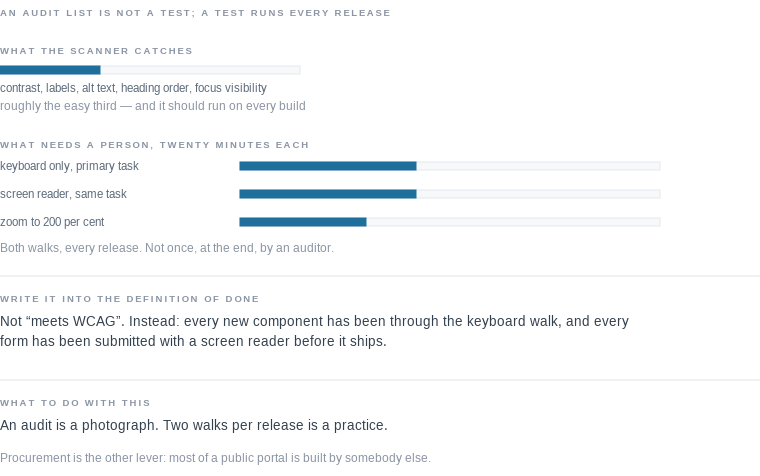
Contrast, labels, alt text, heading order, focus visibility — a scanner finds these reliably and should run on every build. It will not find the things that actually stop people: a modal that traps focus incorrectly, a custom dropdown that ignores the keyboard, an error message that appears without being announced.
So the automated check is a floor, not a pass mark. The rule that works is that a scanner failure blocks the build, and the scanner passing means nothing on its own.
Two walks per release
A keyboard-only walkthrough of the primary task, and a screen-reader walkthrough of the same task. Twenty minutes each, done by someone on the team rather than an external auditor, on the build that is about to ship.
The findings go into the same backlog as everything else, with the same priority rules. Accessibility bugs that live in a separate tracker are accessibility bugs that ship.
Write it into the definition of done
Not “meets WCAG” — that is a project statement. Instead: every new component has been through the keyboard walk, every form field has a programmatic label, every interactive element has a visible focus state, and the scanner is clean on the changed pages.
Four conditions, checked in review, cost about an hour a sprint. That hour is the difference between an audit that describes a past state and a product that keeps getting more usable.
Procurement is the other lever
Most of a public portal is not built by the organisation that publishes it. Design systems, chat widgets, mapping libraries and payment frames all arrive with their own accessibility debt, and the time to discover it is before the contract, not after the audit.
Ask for a conformance report and a keyboard demonstration during evaluation, and write the remediation obligation into the agreement. It is the cheapest accessibility work available, because it happens while there is still a choice.

Working through this now?