Insight · finance
Closing the books is a data flow problem in a finance costume
Nine days to two is rarely about working harder. It is about how many times the same number is keyed in.

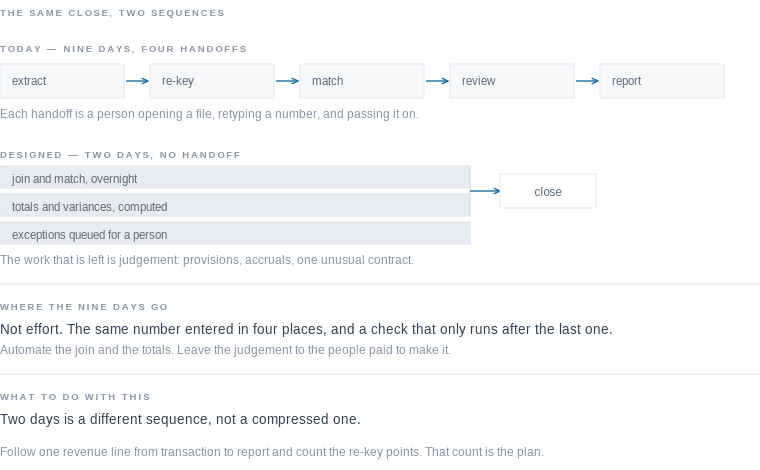
Nine days to close, eleven spreadsheets, four handoffs, and a team that had been told for years the problem was effort. It was not effort. It was that the same number was entered by hand four times between the source system and the ledger.
Each entry point was a control someone had added for a good reason. Each one also added a day of queueing, because the person who owns the next sheet works office hours and the person before them finishes at six.
Find the re-key points
Take the close calendar and follow one number — one revenue line is enough — from the transaction to the reported figure. Every place it is typed, pasted or adjusted is a re-key point. Most closes have between six and twenty.
The useful output of that exercise is not a process map. It is a list of the re-key points ranked by the time they consume, which is almost never the order people expect. The slowest is usually not the biggest sheet; it is the small one that waits for a signature.
Automate the join, keep the judgement
Joins, matches and totals should be computed. Provisions, accruals and the treatment of one unusual contract should not. The mistake is automating the judgement — which produces numbers nobody trusts — while leaving the joins manual, which is where the days actually go.
A test that is worth running: on day one, can the team produce a flash estimate from a single query, and be within a stated tolerance? If the answer is no, the close is a manual assembly, and the calendar is a symptom.
Two days is a design, not a target
Getting from nine days to two is not a compression of the same steps. It is a different sequence: everything that can be computed runs on the first night, everything needing a human is batched into one review, and the exceptions are handled after the number is published rather than before.
That last inversion is the part finance teams resist, and the part that saves the week.

Working through this now?