Insight · healthcare
Dictation fails on the names that matter
Speech recognition is good enough for prose and unreliable for exactly the words a clinical record cannot get wrong.
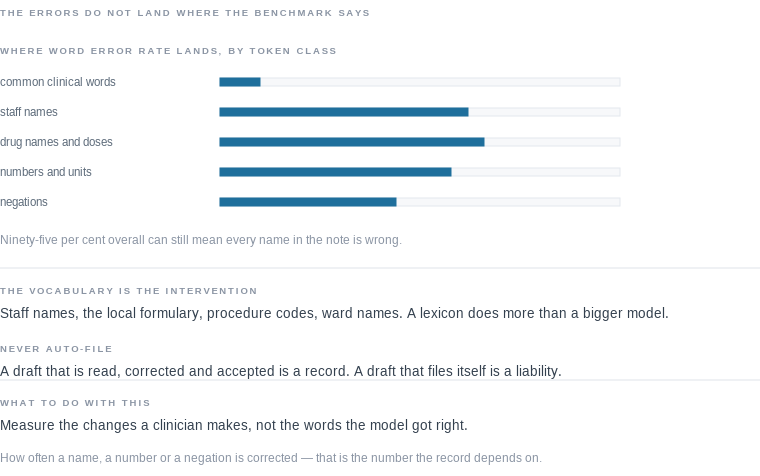
General-purpose speech recognition, applied to clinical notes, reaches accuracy figures that look impressive on a benchmark and fail in a corridor. The failure is not uniform. It clusters on proper nouns, drug names, dosages, laterality and negation — which is to say, on everything that changes the meaning.
“No evidence of” becoming “evidence of” is not a transcription error. It is a different clinical statement.
The vocabulary is the intervention
A specialty lexicon — staff names, local drug formulary, procedure codes, ward names — does more for accuracy than a larger model. It is also the part that has to be maintained, which means it needs an owner and a monthly review, not a one-off import.
Numbers deserve separate handling: dosages and units should be validated against a structured field rather than trusted from free text, and a mismatch should be visible before the note is filed.
Never auto-file
The single most valuable design decision is that the clinician confirms. A draft that is read, corrected and accepted is a record. A draft that is filed and edited later is a liability with a timestamp.
The confirmation screen has to make the risky parts obvious: names, numbers, negations and laterality highlighted, with the audio available at the point of correction. If reviewing takes longer than typing, the tool will be abandoned — so the review step is the product, not an afterthought.
There is a second reason to keep the human in the loop. The corrections are the training signal. A few thousand accepted diffs tell you which words the lexicon is missing, which is a faster route to accuracy than any amount of model tuning.
Measure what the record needs
Word error rate is the wrong metric. The right ones are: how often a clinician changes a name, a number or a negation; how long the review takes; and how many notes are filed without review. The first tells you whether it is safe, the second whether it is used, the third whether the control survives a busy clinic.
Dictation is not a transcription problem. It is a confirmation problem wearing one.

Working through this now?