Insight · concierge
Requests arrive by phone, WhatsApp and memory
A guest request is not a form submission. It is whatever channel the guest happened to reach for.

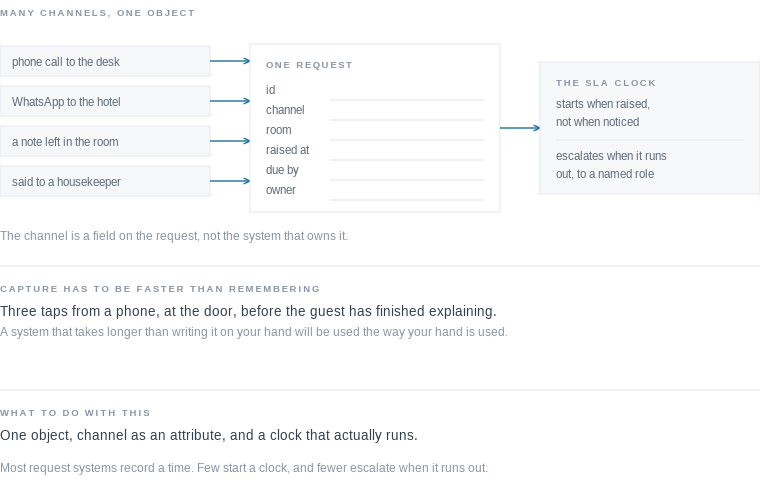
A request for a later checkout can arrive as a phone call to the front desk, a message to the hotel’s WhatsApp, a note left in a room, or a sentence spoken to a housekeeper in a corridor. Four channels, one request, and in most properties four different places it gets written down.
The consequence is not lost requests, though those happen. It is that nobody can answer the only question that matters at 18:00: what is still open, and who owns it?
One object, channel as an attribute
The design that works treats the channel as a field on the request, not as the system that owns it. A request has an identifier, a guest, a room, a type, a due time, an owner and a state. Whether it arrived by phone or by message changes how it was captured, not what it is.
Everything downstream — the queue, the SLA clock, the handover between shifts — then works once instead of four times.
Capture has to be faster than remembering
Staff will not use a system that takes longer than writing it on their hand. Capture needs to be three taps from a phone, with the guest found by room number, and the type chosen from a short list that matches how the property actually talks. Ten options, not forty.
The rest can be enriched later. A request with a room, a type and a time is actionable; a request with twelve mandatory fields is a request that gets taken verbally and forgotten.
The SLA clock is the point
Most request systems record a time. Fewer start a clock, and fewer still escalate when it runs. The clock is what turns a list into an operation: it makes the pending work visible at shift handover, and it makes the exception — the request that has been open four hours — impossible to miss.
Then review the reasons for lateness monthly. They are almost never about effort. They are about a request type that has no owner after 22:00.

Working through this now?