Insight · loyalty
Retention is a data model problem
You cannot measure loyalty you cannot identify. Most retention programmes fail on identity, not on offers.

A membership programme with four tiers, a point balance and a monthly newsletter, and a retention rate that cannot be trusted because two of the four tiers count the same person twice.
Before any of the offers matter, three things have to be true: one identity per customer across channels, events that record what actually happened, and a cohort definition that does not change every quarter.
Identity first
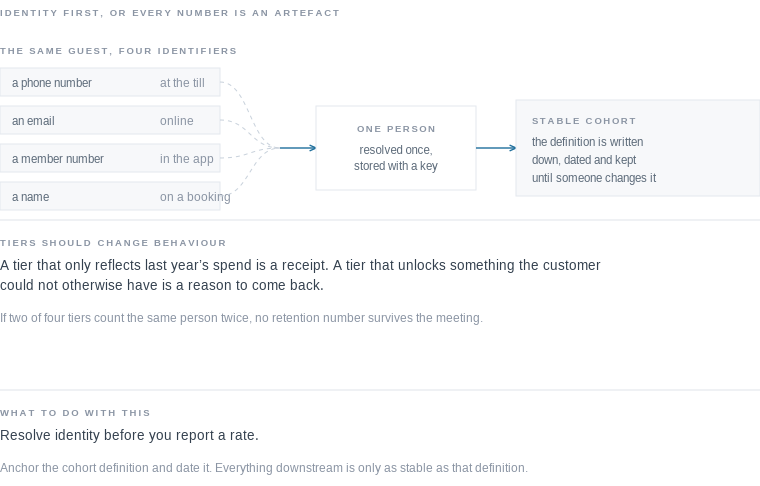
The same guest exists as a phone number at the till, an email online, a member number in the app, and a name on a booking. Resolving those into one person is unglamorous work with a permanent maintenance cost, and it is the foundation of every retention number the business will ever quote.
Match on the strongest available key, keep the evidence of the match, and give operations a way to merge and unmerge. Unmerge matters: a wrong merge creates a customer who is blamed for someone else’s behaviour.
Cohorts must be stable
If the definition of an active member changes between reports, every trend is an artefact. Write the definition down — a purchase within ninety days, say — version it, and never change it mid-comparison.
Then measure by cohort of acquisition, not by month in aggregate. Aggregate retention hides the thing you need to see: whether the customers acquired in a promotion ever came back.
Tiers should change behaviour, not just label it
A tier that only reflects last year’s spend is a receipt. A tier that unlocks something the customer could not otherwise have — a time slot, a service, an entitlement — is a reason to return. The second kind is the only kind worth building, and it needs the operations teams to give something up.
Retention is not a campaign. It is a data model plus an entitlement, and the campaign is what you do once those two exist.

Working through this now?