Insight · loyalty
Points expire; expectations do not
Every loyalty scheme has an expiry rule. Almost none of them has an expiry conversation.

The rule was reasonable: points expire after twenty-four months of inactivity. It was written by finance, approved by legal, and published in the terms. Then forty thousand members lost their balance in the same week, and the contact centre learned about it before the marketing team did.
The value written off was a number in a ledger. The value lost was a relationship, and it did not appear anywhere in the business case.
Breakage is revenue until it is a complaint
Unredeemed points are carried as a liability and released as income when they expire. That release is real money, which is why expiry rules are rarely generous. The trouble is that the same event is experienced by the member as a withdrawal, and withdrawals are remembered.
The design question is not whether to expire. It is what the member knows, when they know it, and what happens at the boundary.
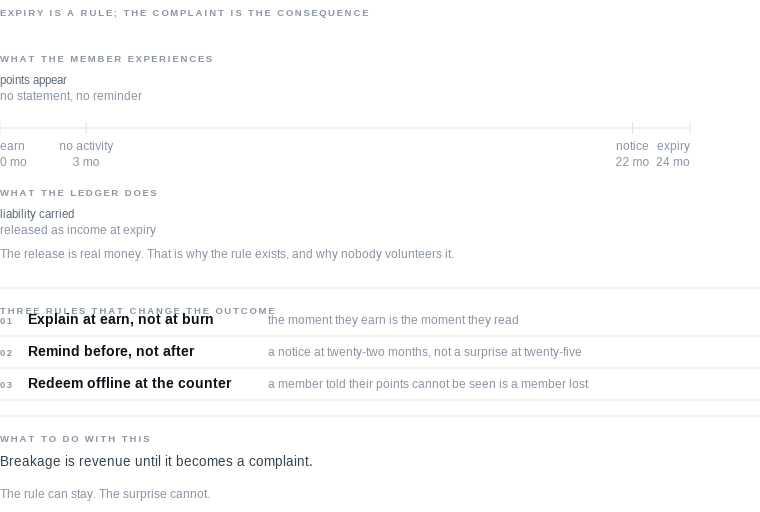
Three rules that change the outcome
- Explain expiry at earn, not at burn. The moment a member earns points is the moment they will read the rule. The moment they try to spend them is the moment they will feel it.
- Warn before, not after. A notification thirty days out, with the balance and the nearest reward, converts a loss into an errand. One sent after the fact converts a member into a complainant.
- Leave a floor. A small permanent balance that never expires costs little and removes the sharpest version of the grievance: the member who was almost entitled to something.
The operational half
Redemption at a counter has to work when the network does not. A member who is told their points cannot be seen is a member who will not try again, and the till is exactly where connectivity is worst.
So the balance check needs a cached fallback, the redemption needs an idempotent identifier so a retry does not double-spend, and the reconciliation needs to tolerate a redemption that arrives an hour late.
None of that is loyalty strategy. All of it decides whether the strategy is believed.

Working through this now?