Insight · fulfilment
The last metre is the expensive one
Fulfilment is measured in promises kept. The picker walking to the wrong shelf is where the promise breaks.
The storefront promises a delivery date. The warehouse has to make it true. Between those two statements sit bin locations, wave plans, a handheld device with a battery problem, and a picker who has been told the item is in aisle twelve when it is in the overflow bay behind the loading dock.
Every fulfilment project we have seen spends its budget on the integration between the shop and the warehouse, and then discovers that the variance comes from the last hundred metres of walking.
Location accuracy beats route optimisation
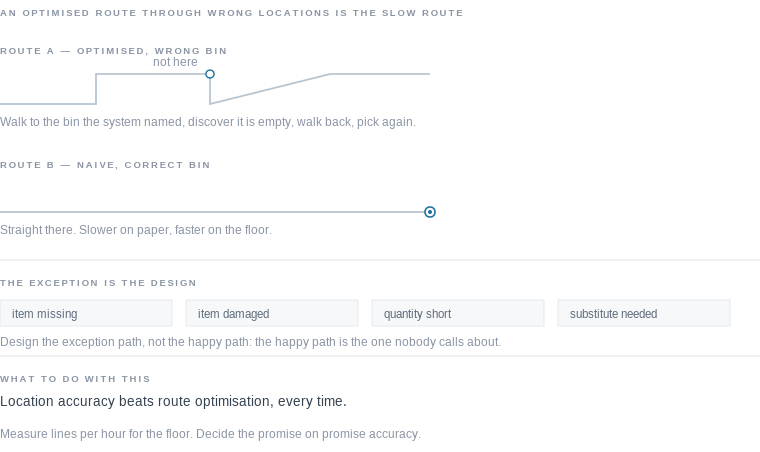
An optimised route through wrong locations is slower than a naive route through correct ones. The unglamorous work — a physical count, a location audit, a rule that an item cannot exist in two places — returns more than any algorithm applied on top of bad data.
The same is true of stock accuracy. A promised date is a function of what the system believes is on the shelf. If that belief is ninety-five per cent right, one order in twenty starts with an apology.
The exception is the design
Every pick has a normal path and an exception path: item missing, item damaged, quantity short, substitute required. Most systems treat the exception as an error to be reported. The warehouse treats it as the job, because exceptions are where the time goes.
A workable exception flow has three properties. It is reachable in one action from the device. It captures a reason from a short list, not free text. And it immediately updates the promise the customer was given, rather than leaving the storefront to discover it later.
Measure lines per hour, decide on promise accuracy
Productivity metrics are useful for the floor and misleading for the business. The number that decides whether fulfilment is working is the proportion of orders delivered inside the promise, and the reason code attached to each miss.
That reason code, aggregated over a month, tells you whether to buy another scanner, fix the location data, or stop promising next-day on a product line that ships from three hundred kilometres away.

Working through this now?