Insight · workforce
The roster is the real integration
Every workforce system claims to schedule people. The hard part is that a shift is also a wage, a door pass and a till login.

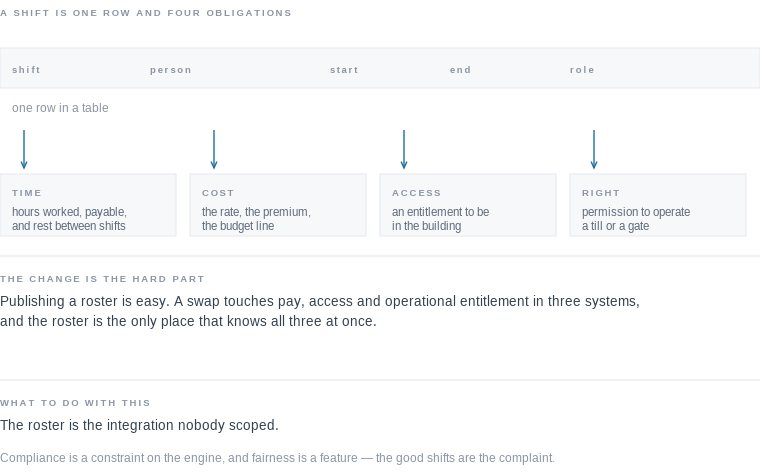
A shift looks like a row in a table. Operationally it is four things at once: a person’s time, a cost, an entitlement to enter a building, and a right to operate a terminal. Get the first one right and the other three go wrong quietly, which is why scheduling projects are usually declared successful and then argued about monthly.
Compliance is a constraint, not a report
Working-hour rules — rest between shifts, maximum weekly hours, break entitlements, minimum notice of a change — are usually implemented as warnings after the roster is built. A roster that can be built illegally and then flagged is a roster that will be built illegally on a busy Friday.
Model the rules as constraints in the engine. The scheduler should not be able to propose a pattern that breaches rest, and when it cannot cover a shift legally, that is the moment to escalate — not the following month in an audit.
The change is the hard part
Publishing a roster is easy. Changing one is where systems fail, because a swap touches pay, access, and the operational plan simultaneously. The person who takes the shift needs the door to open at the new time and the till to accept their login, and neither of those systems knows what a swap is.
So the roster publishes events, not just rows: shift assigned, shift released, shift swapped, shift cancelled. Downstream systems subscribe and reconcile. Without that, every swap generates a manual fix, and manual fixes accumulate into a shadow process that outlives the project.
Fairness is a feature
The complaint that ends scheduling projects is not about hours. It is about who gets the good ones. If the engine cannot state the rule it used — rotation, seniority, preference, or a mix — the team will invent one, and it will be worse and less visible.
Write the fairness rule down, apply it consistently, and show it. A roster people can argue with is a roster they will use.

Working through this now?